Nurse Manager Leaves Career with Corner Office to Take Care of People
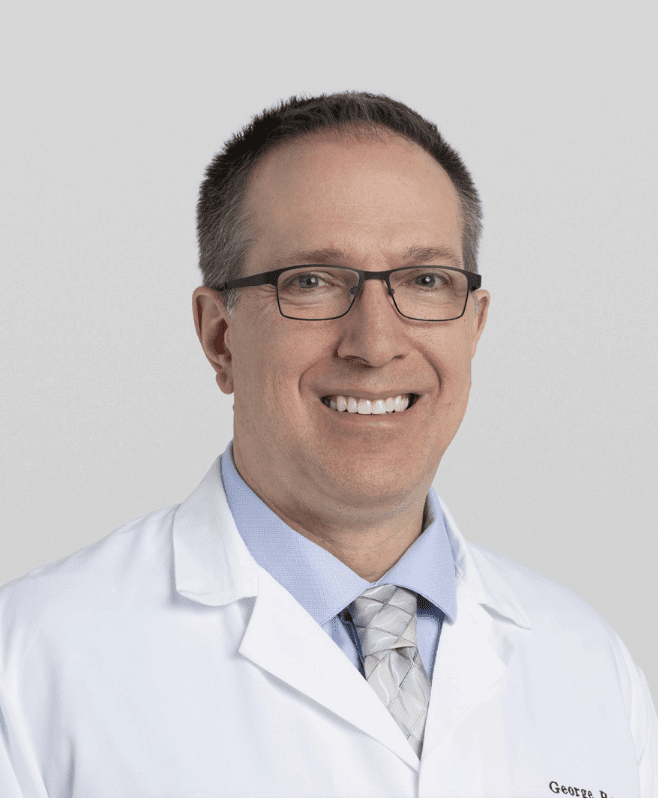
 After graduating from high school in 1984, George Rouse began working in computer programming, spending several years at a carbide cutting tool company. “We made razor blades for cutting steel…for refrigerators and car doors,” George says. But after years in the business world, he knew he wanted something more meaningful. “I’m over this,” he recalls thinking. “I don’t want to look back on my life as someone who sat in a corner office under a fluorescent light and had nothing to do with people.”
That realization led him to quit his job and return to school to pursue nursing.
George attended the University of Akron as a first-generation college student, where he earned his Bachelor of Science degree in 1998. “I went to the University of Akron because that’s all I knew. If you wanted to go to college, that’s where you went,” George says.
During his senior year in 1997, he took a job as a Patient Care Nurse Assistant (PCNA) at Cleveland Clinic, working 12-hour shifts every Saturday and Sunday while finishing school. “I had to plan out my schedule a little bit to get all of my homework done because I didn’t have the weekend to do it,” George says.
Complex Care for Patients
A Nurse Manager for J71 and J73 (cardiovascular step-down telemetry units) at Cleveland Clinic’s Main Campus since 2017, he and his nursing team of 145 caregivers treat a wide range of patients with acute illnesses that often involve multiple body systems, primarily cardiac, but also including neurological, pulmonary, renal and gastrointestinal conditions. Many patients receive high-risk medications such as nitroglycerin, dobutamine, dopamine, milrinone and IV heparin. “Our nurses are very proficient in providing complex bedside care and managing the advanced medications we’re using,” George says.
He adds, “Most of the patients on my two units would be in the ICU at many hospitals, but we care for them in our cardiac step-down units. They come here because we’re Cleveland Clinic and we’re really good.”
Communication is Key
One of the things George takes great pride in is the communication that takes place within his unit. “I’m really big on communication,” he says. “Anything that I know, the staff knows.”
Twice a day – at 7 a.m. and again at 7 p.m. – he and his team gather for huddles, checking in on how everyone is doing and how the previous shift went. “I think it’s a good thing for people to see that we care about each other and to create a positive environment.” And for George, no question is a bad question.
New Grads…Neverending Learning
George stresses the importance of education in these units, noting that both experienced RNs and New Grad Nurses will continue to learn. “We get a lot of new grads, which is great because we train them and educate them with the role. I tell them this is the best place to work, and these are the best nursing units to get your feet wet,” George says.
“When they’re on the floor, we really encourage them to continue expanding their horizons. They can become skill-certified for central line and IV access, take EKG classes and pursue specialty roles that match their interests. There are so many opportunities to grow professionally while you’re here, and many of these certifications also come with additional compensation, along with the benefit of adding valuable credentials to your experiences.”
He also makes a point to highlight our tuition reimbursement and loan repayment programs, which help RNs pay off student debt or even afford to continue their schooling.
Virtual Visits
It’s nearly impossible for George to hide his enthusiasm during interviews, including virtual interviews. If a candidate has an iPhone, he connects via FaceTime to walk them through the unit on a virtual tour, introduces them to team members and gives them a real sense of what it’s like to work there.
He also talks about the strong learning environment on the unit, sharing that nursing students from schools such as Tri-C, Cleveland State and Case Western Reserve start there as PCNAs and choose to stay on with the team after earning their nursing degrees.
The Best of Both
George sums up the purpose at his role in one final sentence: “There are two reasons I’m at Cleveland Clinic: for patients to have the best care and the best outcomes and a great experience here, and for caregivers to have a great day at work with lots of growth and development.”